Archive for the ‘Media art’ Category
- In: Art | Installations | Media art | Software | Software art | Technology art
- Leave a Comment
In September I was on holiday in the Baltic states (and in St. Petersburg and Moscow in Russia). In Riga I bought a book-which-actually-is-a-magazine called “Systems” (edition of 500 copies, ISSN 2255-9310, Popper Publishing) dedicated to contemporary and post-internet art in the Baltics (and Russia).
One of the most interesting art works (on page 82) in this book/magazine was Untitled from Latvian artist Victor Timoveef. I became curious and visited his website where I found more interesting works, such as the computer generated Soft War images:


So who is Victor Timofeev? The bio on his website doesn’t provide much information, but he recently had a solo exhibition in the Drawing Room in London, called S.T.A.T.E. Suprisingly, the Drawing Room is “the only public and non-profit gallery in the UK and Europe dedicated to contemporary drawing”. Here some more info on the digital (?) artist can be found:
“Viktor Timofeev was born in Latvia in 1984, studied at Hunter College, New York and is currently completing his MFA at the Piet Zwart Institute in Rotterdam, Netherlands. Viktor Timofeev’s practice combines drawing, digital and sculptural work. [He] creates installations with digitally generated imagery, interactive games and rule-based performances. He is a prolific draughtsman but also makes computer games and browser based collage puzzles without instructions. This [digital] work runs parallel to a drawing and painting practice from which his logic and inventions spring and which are collectively grouped as S.T.A.T.E., a title conceived by Timofeev in 2013.
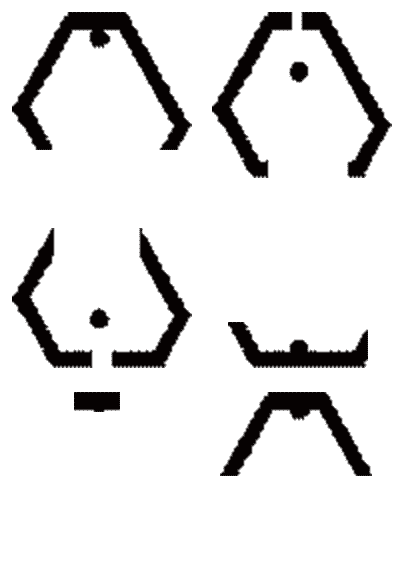
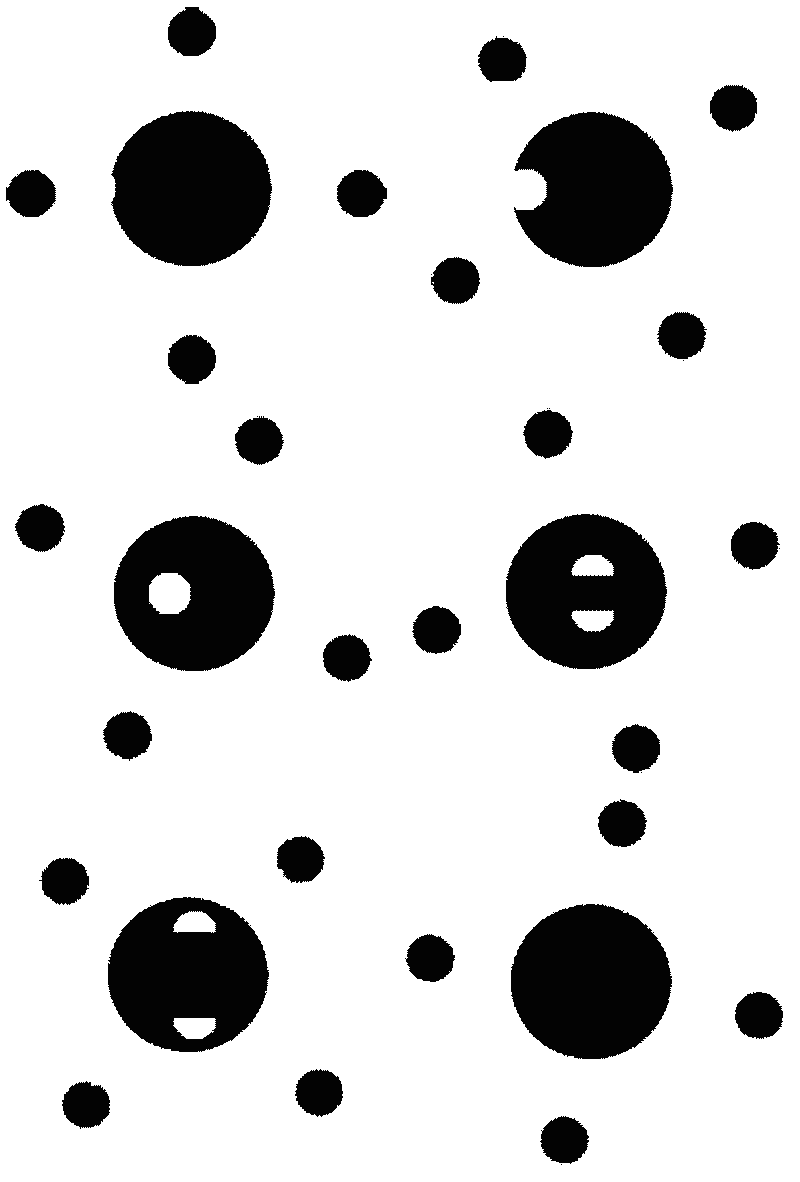
So there is also a Dutch connection… Being a web developer myself, I was triggered by the browser based collage puzzles without instructions part of the bio. This refers to a work called Selekthor. Selekthor is a looping collage-based puzzle without instructions written in native Javascript, originally hosted at minerpie.net, but now embedded in his website. If you click on one of the images below, the web page with the puzzle is opened:
   |
You didn’t click? Here is a video demo of the puzzle, which might make you change your mind:
Timofeev also participated in the thelimitedcollection on Tumblr, a collection of animated gifs made by various digital artists:

So a very interesting Latvian artist to follow whose work ranges from drawings to javascripts. Check these links to find out more:
- Viktor Timofeev website
- The Drawing Room
- thelimitedcollection on Tumblr
- Popper Publishing
- In: Art | Conceptual art | Experience | Installations | Media art | Software | Software art | Technology art | Videos | Web sites
- Leave a Comment
Every technology has its own accidents. Rosa Menkman is a Dutch media artist who focuses on visual artifacts created by these kind of accidents in digital media. The visuals and installations she creates are the result of glitches, compressions, feedback and other forms of unplanned noise.
Although most people perceive accidents as negative experiences, Rosa Menkman emphasizes their positive consequences. By combining both her practical as well as academic background, she merges her abstract pieces within a grand theory (“glitch studies”), in which she strives for new forms of conceptual synthesis of the two.
Glitch art seems to be an art form which requires a considerable amount of – rather obscure – explanation. According to Menkman, “glitch art is best described as a collection of forms and events that oscillate between extremes: the fragile, technologically based moment(um) of a material break, the conceptual or techno-cultural investigation of breakages, and the accepted and standardised commodity that a glitch can become. […] Glitch genres perform reflections on materiality not just on a technological level, but also by playing off the physical medium and its non-physical, interpretative or conceptual characteristics. To understand a work […] of glitch art completely, each level of this notion of (glitch) materiality should be studied: the text as a physical artifact, its technological and aesthetical qualities, conceptual content, and the interpretive activities of artists”.
and audiences.”
If this description confuses you: it is – more or less! – explained by Rosa when interviewed for the Digital Manifesto Archive:
So much for theory. How does this actually look and/or sound? Below are a few video’s included of works made by Rosa Menkman.
Pattern Recognition, Beyond Resolution
This video was apparently commissioned by the Dutch railways to be played on big LED ‘Urban Screens’ in train stations all over the Netherlands. However, when finished it wasn’t used because it was classified by the railway company as being “to strange for train passengers”:
DCT:SYPHONING
This installation is part of the Transfer Download exhibition of the Minnesota Street Project in Transfer Gallery in San Francisco, which ends on September 9, so next week. So you are actually still able to see/experience it if you are living near SF!
According to the Transfer Gallery website this work is inspired by the 1884 novel ‘Flatland’ by Edwin Abbott Abbott. Rosa Menkman tells the story of a father who introduces his son to different levels of compression; they move from dither, to lines, to macroblocks (the realm in which they normally resonate) to the ‘future’ realms of wavelets and vectors.
Xilitla
Xilitla is a software game/application for Windows, Mac and Linux platforms which enables you to view the videoscapes of Rosa Menkman in glitchy way outside the confines of YouTube and Vimeo (or this blog page..). The app can be downloaded for free on the Xilitla/Beyond Resolution website. In the About Xilitla video below she explains the goal and concept behind the app:
All in all, a very interesting Dutch media artist,who combines art theory and practice in her work and has in doing so already produced an extensive body of media art pieces around the concept of “glitch”. Below are some links – in random order, of course – to get you viewing, playing and reading:
More info:
- Rosa Menkman blog
- “Resolution Disputes: A Conversation Between Rosa Menkman and Daniel Rourke” interview on Furtherfield
- “The Glitch Moment(um)” book by Rosa Menkman published by the Institute of Network Cultures
- “The Glicht art genre” article by Rosa Menkman on Fluxo
- Digital Manifesto Archive
- Xilitla/Beyond Resolution website
Digital art – Who cares?
Posted on: September 2, 2016
- In: Art | Media art | Software | Videos
- Leave a Comment
Found on ArtTube.nl: a very interesting documentary (in Dutch, but with English subtitles) about the issues of preserving digital and software driven art works over time.
As these art works are software or make use of software, they age very fast because computers, storage media, operating systems and programming languages develop rapidly. This poses a challenge for museums who buy these art works. The documentary illustrates this problem by discussing the preservation of works of artist Peter Struycken, the Dutch pioneer of 20th century digital art, whose works have been acquired by most Dutch contemporary art museums. An excellent opportunity to get acquainted with this important Dutch artist and some of these Dutch art museums:
More info:
- ArtTube.nl
- Peter Struycken website
- In: Art | Experience | Installations | Media art | Sound art | Technology art | Videos
- Leave a Comment
Found today while browsing on YouTube: a video of the Parallels installation of Nonotak Studio, one of the highlights of the STRP Festival 2015 edition:
Nonotak Studio is a collaboration between illustrator Noemi Schipfer and architect musician Takami Nakamoto. Nonotak was created in late 2011.
In early 2013, they started to work on light and sound installations, capitalizing on Takami Nakamoto’s approach of space & sound, and Noemi Schipfer’s experience in kinetic visual design.
Parallels is an audio visual installation that was commissioned by the STRP festival. It explores interactions between light, space and people within the room of the installation. The boundaries and notion of space, become abstract as the audience crosses the room, but in doing so, the audience also affects the space by breaking the light. This installation is strongly connected to the space in which it takes place; it lives within it. But as soon as the light hits the walls that define the space, it reaches its limits and stops reproducing itself.
More info:
A new laser-and-sound installation by Robert Henke a.k.a. Monolake: Fall.
Fall has apparently been inspired by the drowned Bavarian village Fall, as can be read on Robert’s website:
“In the 1950s the village of Fall in the south of Bavaria slowly disappeared under the rising waters of the newly built Sylvenstein water reservoir. In 2015 the reservoir had extremely low water. Ruins of the old village became visible again; remains of walls forming broken grid-like structures, usually submerged below the water surface. These images became the inspiration for this installation.”
It was premiered at the LEV Festival in Gijon, Spain in April. In his tech blog, Robert Henke explains how it was done.
More information:
 nnnoises